Jiuchongtian Hereditary Hall in Zhangjiajie | Travel Guide
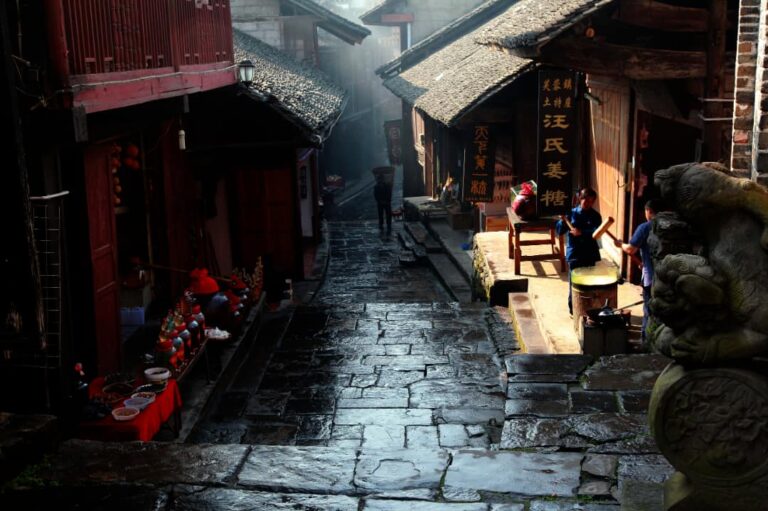
Jiuchongtian Hereditary Hall is a national 4A-level attraction located just 10 minutes from Zhangjiajie Railway Station and Bus Station. Known as the No.1 Wooden Diaojiaolou (stilted building) in China, it represents a classic Chongtian Tower: an all-wooden architectural masterpiece built along the hillside with upturned eaves, carved beams, and painted pillars. It is majestic, ornate, and entirely nail-free.
Location of Jiuchongtian Hereditary Hall
Jiuchongtian Hereditary Hall is inside the Tujia Folk Custom Park in the Yongding District of Zhangjiajie.(In the surrounding areas of Zhangjiajie)
Navigation Address: Tujia Folk Custom Park, Wuzipo, Nanzhuangping, Yongding District, Zhangjiajie.

Historical Background
The Tusi (Native Chieftain) System originated during the Five Dynasties and Ten Kingdoms period and became fully developed in the Ming Dynasty. Western Hunan once had three major Tusi clans:
Xiang Clan of Sangzhi
Peng Clan of Yongshun
Zhang Clan of Cili
Among them, the Peng Clan of Yongshun’s Xizhou Tusi was the most powerful. Unlike other Tusi rulers who built only one Tusi City, the Peng Clan built two—one in Yongshun and one in Yongding.

To symbolize their supreme status, the Peng Clan built the tallest diaojiaolou in Western Hunan inside their Yongding Tusi City. Remarkably, the entire building was constructed without a single iron nail, making it a miracle in Tujia wooden architecture.
In September 2002, it was recognized as the tallest diaojiaolou in the world and recorded in the Guinness World Records.
Today, the hall functions as a comprehensive exhibition of Tujia culture, featuring Tujia marriage customs, traditional costumes, batik and brocade weaving, silver- and stone-crafting, root carving, and many other folk displays—each floor presenting a unique aspect of Tujia heritage.
Overview of Jiuchongtian Hereditary Hall
The building has nine floors, each dedicated to a different cultural theme.
1st Floor — Ancestral Hall
Introduces the origins of the Tujia people, who have long lived in the Wuling Mountains across Hunan, Hubei, Chongqing, and Guizhou.
Six statues are displayed here, honoring historical figures such as Ming Dynasty anti-piracy hero Peng Mingfu, along with Tang Ren, Tian Shijue, Peng Jincheng, Peng Jinan, and Qin Yaozhi.

2nd Floor — Migration Hall
Features cave dwelling models showing how the earliest indigenous ancestors lived.
As early as 50,000–100,000 years ago, they were already using flint to make fire and cook food.
3rd Floor — Life & Growth Hall
Displays scenes of Tujia people living, farming, and multiplying on this ancient, fertile land for generations.
4th Floor — Farming & Warfare Hall
Exhibits tools used for fishing, hunting, and farming, as well as ancient weapons—reflecting the traditional Tujia social structure that combined both military and political roles.
5th Floor — Chief Jingfu Hall
Showcases the deeds of Xiang Dan Cheng, a local Tujia chief (Jingfu) from the Zhangjiajie region.
6th Floor — Hou Wang Hall
Displays a model of the Xizhou Copper Pillar, listed as a National Key Cultural Relic Protection Unit in 1959.
The copper pillar was erected in 940 AD during the Tianfu era of the Later Jin Dynasty, marking the territorial boundary between King Ma Xifan of Chu and Tusi governor Peng Shichou of Xizhou.
7th Floor — Integrity & Aesthetics Hall
Here you’ll find traditional Tujia wooden window carvings collected from various regions.
These works from the Ming, Qing, and early Republic eras include relief carvings and openwork carvings, displaying refined craftsmanship, depth, and artistic elegance.
8th Floor — Transition Hall
Explains the “Gaitu Guiliu” reform during the Yongzheng reign of the Qing Dynasty, which replaced the Tusi system with a centralized administrative system after 877 years.
After the reform, agriculture and commerce prospered rapidly, leading to the rise of exquisite Tujia handicrafts such as carved beds, round tables, screens, decorative panels, cabinets, and wash stands—all displayed on this floor.
9th Floor — The Ninth Heaven
The topmost level honors King Qin Hou, a revered Tujia leader in Zhangjiajie.
His placement on the highest floor symbolizes the people’s highest respect.
Jiuchongtian Hereditary Hall Opening Hours
08:30–18:00 year-round.
If you plan to visit all attractions inside the park, expect to spend around 4 hours. It’s recommended to plan your itinerary in advance.
Ticket Information
You only need to purchase the Tujia Folk Custom Park entrance ticket.
Reference Price: RMB 60
The park also includes attractions such as:
Tusi Castle
Baishou Hall
Tujia Mountain Village
Hou Wang Palace
Official Contact Number
0744-8230597
Near Jiuchongtian Hereditary Hall, you’ll also find the following scenic spots rich in local character, well worth a visit.
Where is 72 Wonder Tower, 72 Strange Buildings (72 Qilou) Tickets
Fenghuang Ancient City Xiangxi Tips with Route, Transportation, Accommodation, Food, Tickets